

I don’t often write reviews here, and this is a review which I will also use to make some general points. But I’d like to talk about the book just out from Professor Norman Fenton. This book:
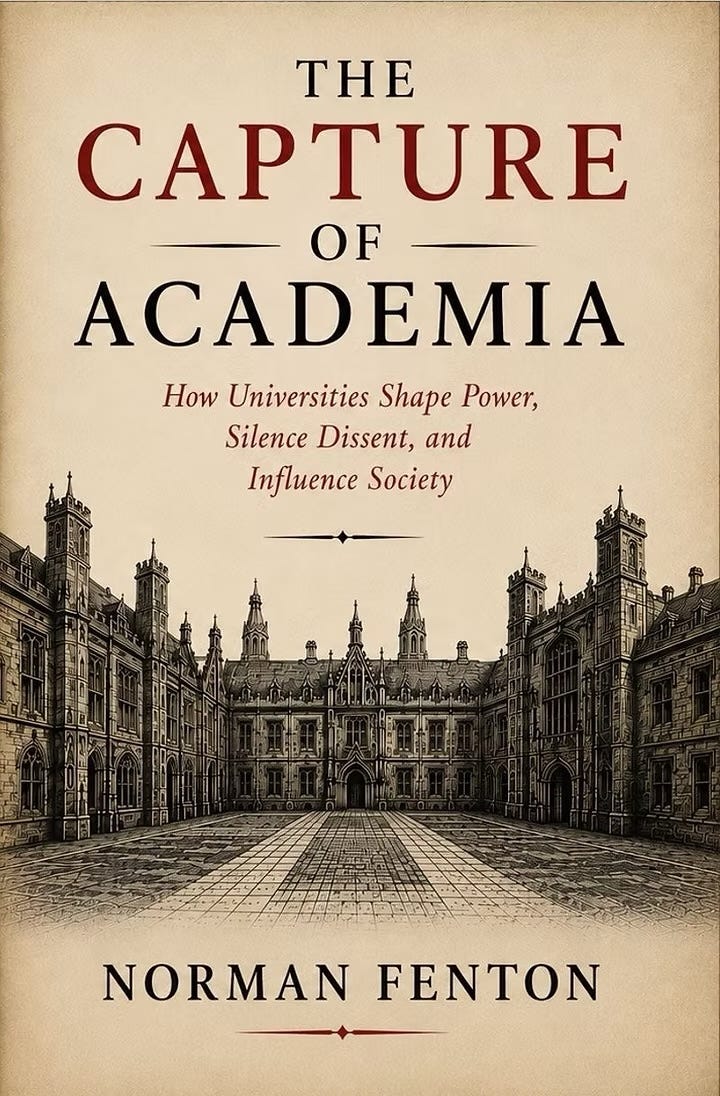
It is an excellent read, and an important one.
But first I should make it clear that I know the author. Over the last couple of years Professor Fenton has become a personal friend of mine. I regard him as a friend and as a good man, whose wisdom and insight I admire.
So is this just one right winger promoting another?
Well, if it is, that isn’t such a bad thing. The other side have most of the money, most of the institutional power, and most of the backing. I actually think those who are still on the right now have a moral duty to promote each other.
But if Norman or any friend on the Right produced a book I thought was inferior, I’d probably maintain a polite silence. I don’t need to be silent about this book.
It covers a topic many of us are already familiar with to some extent. We know that universities are overwhelmingly staffed by leftist academics. Polling confirms that 90% of British academics voted Remain rather than Leave. The same ratio now applies to whether academics vote for the Left or the Right (in both the UK and US). By the mid 1990s in the US (and even earlier in the UK) rightwing intellectuals and academics became vanishingly rare. Many were rejected at interview stage for posts even if they acquired PhDs (I myself was one of those). Those already established fled to a few think tanks. The creation of inherently leftist disciplines and the surge in DEI initiatives accelerate this shift.
We know that there are many courses and disciplines that promote often extreme leftwing positions. Critical race theory, critical theory generally, gender studies, women’s studies, feminist studies, black studies, postcolonial studies, whiteness studies, gay studies, Islamic studies, decolonising the curriculum….all of these present variations on the theme that Western Civilisation is built on racism, sexism, suppression of minorities of all kinds, imperial oppression and white supremacy and that non-white, non-western voices are morally, intellectually and even spiritually superior.
All of them were invented by extreme leftists, and exist to present an extreme leftist view of culture, history, and identity. Many of them are openly supremacist about other cultures, religions and even genders or sexual orientations (while ignoring contradictions like simultaneously supporting LGBTQ+ activism and Islamic supremacism in the same institution and set of values).
Most of us have heard of the Frankfurt School and are aware for example that since World War Two university curriculums have been shaped quite often by people who are self declared Marxists. Indeed, a particular issue I always refer to is that Marxist historians have shaped the modern understanding of World War Two which has had a devastating impact on subsequent thought and politics.
That academia treats ‘Marxist historian’ as if Marxism is a neutral or objective tool of enquiry that can be deployed without distorting history, that it treats Marxist criticism as objective analysis, was probably one of the very first signs of the corruption of academia that is the topic of Fenton’s book.
But, and I have looked into these things for a long time myself, Fenton isn’t just telling us things we already know. He is somewhat uniquely positioned to draw the threads together and present a comprehensive analysis, informed by personal experience, of the decline of the university system. Of other figures who have done so, I can only think of Jordan Peterson and Bret Weinstein as having the same level of informed experience to draw from.
This is because Fenton’s own academic credentials are impeccable. Fenton comes from a working class background and describes a tough but loving early life with far fewer material comforts than most embittered and whining middle class socialists now enjoy. Both his parents were Jewish exiles of oppression, and early circumstances in England were difficult:
“We lived on the third floor of a tenement shared by six families. Our empire comprised two rooms. One had a tiny kitchen with a metal sink-cum-bath, a table, and my parents’ bed. The other was a small room that I shared with my siblings. There was no bathroom in the building and just one shared toilet for all six families.
Grim as it sounds, it was all we knew, and we were not unhappy. Our street, Albert Gardens, a three-sided square of Georgian houses abutting Commercial Road, had a lovely garden (still there today) at its centre, where we played constantly.”
This small personal reflection is I think highly telling about where Fenton’s book is coming from and perhaps why, unlike many others in academia, that after forty seven years in a system that increasingly taught everything through a leftwing lens of grievance, Fenton was able to resist that kind of indoctrination. The difficulties Fenton’s family endured were overcome through hard work, determination, and merit. These weren’t the kind of imaginary sufferings that go into so many Ta-Nahisi Coates and Ibram X. Kendi type modern racial grifting narratives (which are so closely tied to the disciplines and attitudes that have destroyed academia).
Here, for example, is Fenton’s description of his father’s life, which is actually moving in its stark simplicity and lack of emotive declaration:
“My father, Ben Finkelstein, was a Holocaust survivor from Poland, the sole survivor of his large family. After escaping the Łódź ghetto in 1940, he reached the Soviet-controlled zone but was deported to a labour camp in Siberia, where he endured brutal conditions before later joining the Free Polish Army under British command.
At the end of the war, with Jewish immigration to Palestine restricted under the British Mandate, Britain became Ben’s new home. Honourably discharged in Scotland in 1947 and granted citizenship, he settled a year later in Stepney, East London, and found work as a tailor, which he had done since he was 11 in Poland. He spoke little English and had no formal education.”
What is so important to note here is that this is a family who looked to England with gratitude as a place of rescue, an attitude I would argue is very different, indeed opposite, to that of many other immigrants in more modern times and equally opposed to the narratives of Western evil that dominate modern academia. And Fenton’s approach to it is typical of his general character and the character that would resist political indoctrination in the university system-the old and positive migrant traits of making a better life are real here, accompanied by an appreciation of freedom and a matter of fact pragmatism that would also serve Fenton well in the fact based rigour he applies to both politics and research.
Fenton has always been grounded in the real world, and always living a traditionally worthy version of how you improve both your own life and those of others-through merit, work, effort and intelligence. From this humble beginning, which is not presented with any of the bitterness, affectation and fiction building self mythology of less accurate memoirs, Fenton’s intelligence earned him a grammar school scholarship and a funded university degree. But nobody promoted him because he was Jewish, or the son of migrants, or some special DEI initiative existed.
He earned it.
And boy, did he earn it. Fenton became one of the most respected figures in his field. He is a master of statistical analysis, particularly Bayesian risk analysis, and has worked in a fascinating array of capacities applying this methodology to everything from computer engineering to criminology. He has led significant research teams, co-founded a company, authored a statistics bestseller which became a standard text for the subject, built a genuinely respectable research profile, and managed major research grants.
Part of what’s excellent in the book is that this background allows Fenton to discuss the things that have gone wrong with academia that are not as obvious as a Marxist march through the institutions. The very structure of research being prioritised over teaching also leans towards the production of nonsense research simply to meet the competition to publish. The academic journal lowers standards to get the number of articles they need, and the academic offered a huge grant to study something absurd is not going to decline it. If the system starts favouring absurd research from absurd people, if that’s where the funding is for various ideological reasons, academics will churn out more and more nonsense. The funding system provides State backing so academics can live in a bubble not touching reality or being corrected by market pressures, and simultaneously allows malign foreign governments or individuals to purchase influence over education through large grants and endowments.
Fenton saw this in operation, while himself remaining true to much more rigorous and objective standards.
He was, and is, undoubtedly one of the top statisticians in the UK.
This expertise is genuine, but also put him in the heart of the academic system he now questions. Again, he is typically honest about this, stating that for a long time he didn’t question the system because he was one of the people being rewarded by it. Not only did he jump through the hoops and go through the measures needed to succeed and rise in academia (short of authoring nonsense), he admits too that he shared the general political assumptions of the academic class. He entered academia as a leftist, and was a member of the Labour Party for a long time.
The book cites multiple factors eliciting a change in this complacency, and a growing unease with the system before Fenton himself became a victim of cancel culture. In 2016 Fenton witnessed responses to Trump’s election and the UK Brexit referendum vote that shook his confidence in the classical liberal notion of respect for diverging opinions. Rather than competing with the ideas behind Trump or Brexit, Fenton noticed that his fellow academics supplied nothing but scorn, ridicule and contempt for voters who backed Trump’s election in the US and the Brexit referendum in the UK. He saw academics refusing to discuss why people might vote these ways and instead simply dismissing those people as stupid, ignorant, and morally perverse. Fenton had thought that his generally leftist politics, shared with most of academia, were supposed to value free speech, political difference, and the right of the working class to vote for the candidates and policies they preferred.
He found that the academic consensus had become that if the working class votes for anything other than the people and policies academics support, the working class is vile and stupid.
Similar moments of academic and leftist prejudice becoming startlingly clear crop up throughout the book. Fenton is very much a classical liberal who believes in scientific evidence, rational enquiry, and free speech. Ironically, these attitudes put him on a collision course with much of the rest of academia and proved to him how much the university system had abandoned these founding principles. Fenton first received academic push back and a stalling of his career by questioning climate change orthodoxy. Hired as a co-presenter of a BBC climate change documentary, Fenton made some cautious, polite and accurate challenges to some of the evidence presented. He cites how he seems to have been subsequently black-listed by the BBC.
The huge turning point though came with COVID. From being a respected figure, Fenton’s academic career was destroyed for challenging (using Bayesian analysis and risk analysis expertise) the necessity of draconian COVID measures. Fenton’s frequent research partner and close collaborator Martin Neil also strongly challenged (using completely orthodox and established scientific and statistical methodology) COVID measures.
Fenton describes how long standing colleagues suddenly refused to take his calls, how other academics publicly denounced him, and how grants, collaboration offers and invitations to lectures and symposiums all dried up the instant he challenged the COVID policies being enacted.
Again, none of this is presented hysterically or emotionally. It is anything but a ‘poor me’ victim narrative. Indeed, at times, it becomes very clear that his own treatment is actually not his primary concern at all. What horrifies and worries Fenton is the general decline of an academia that can no longer listen to and debate opposing views on anything, that can embrace the total absurdities of identity politics and Hard Left thinking, but which has no space for rigorous scholarship and fact driven questioning and criticism of established narratives.
None of Fenton’s arguments rely on these critiques of academia being ‘my truth’. None of them are primarily concerned with Fenton’s own experience. Instead, he uses that experience, along with those of others, to analyse why the university system has gone so disastrously wrong and what can be done to fix it.
The final area of disagreement between Fenton and academia and the university system, of course, is in attitudes to Israel. As the son of a Holocaust survivor, with a large number of relatives wiped out by that horrific crime, and as a Jew with relatives in Israel, Fenton has been a strong voice opposing many of the lies and absurdities that have shifted so much western opinion against Israel and, just as obviously, against Jews. Tragically, both the mainstream academia that refuse to listen to his wise points on their prejudices and errors over Trump, COVID and climate change hysteria, and many of the alternative and outsider voices who agreed with Fenton on COVID, have succumbed to an extraordinary resurgence of purely irrational antisemitism. Here, too, Fenton has calmly positioned himself on the side of informed awareness, scholarly depth of knowledge, and objective real world facts.
For these responses modernity has judged Fenton as a ‘far right’ figure, a figure subject to all the extreme personal insults that can be applied by the radical left and a captured mainstream to those still insisting on truth, merit, and liberty while taking the time to ground everything they say in facts rather than radical opinions.
It is my belief that any true history that comes from future pens will recognise Fenton as one of the last truly great academics, one of the last people from the system who proved resistant to contemporary political extremisms in all forms.
Read The Capture of Academia and you will see what I mean.
NB, Other Sources:
Or you could also follow our discussion of the book here, since I interviewed Norman on it:
It’s a 40 minute interview of Norman discussing the issues in the book.
Norman’s book can be obtained here:
https://www.normanfenton.com/capture-of-academia
Highlight and click the option to open link.
Here’s a great post of Professor Fenton describing the “probability fallacy” of the UN IPCC’s claim of 95% certainty that most of the global warming of the last century was due to human activity. In fact the 95% figure has no scientific backing seems to have been plucked out of thin air. He recounts how a professor who drafted the fallacious script Fenton was obliged to speak in his BBC programme admitted afterwards that “we all have to lie for the greater good”: https://www.youtube.com/watch?v=9kkjFySmA90.
Daniel: thank you for this amazing review and for the interview